Sunday, December 15, 2013

Listerine Advert Analysis

Listerine Advert Analysis


Listerine is a brand of antiseptic mouthwash, it kills germs that causes bad breath.

Listerine helps strengthen teeth, freshen breath, kills bad breath germs and cleans the whole mouth. The product is to provide you with a fresher breath and to feel fresh every morning.

In the 1920's the target audience for the Listerine product were mainly achieve to young women's. Listerine capitalized on the fact that as young women age they couldn't find their true love because of their bad breath, they were unaware that even though he loved her, he couldn't stand the bad smelling breathe from the women mouth. This represents women as being weak without a husband or subservient to men. Essentially, Listerine wanted all of the single women's to believe the reasons they couldn't find a man to settle down with was because they had breath and none of their friends wanted to tell them. Listerine was to show that if the single women's used their mouthwash they wouldn't have to worry about it anymore.

In the poster words like tragic and pathetic are used to make women afraid of being single. This was commonly used in the past adverts to persuade young women's buying the Listerine product, so they don't have a bad smelling breath.
There is also repetition of the word bad breathe used in the poster to persuade you buying the Listerine product.This gives you more advice's of why should buy their product, it reminds you of your bad experience having a bad breath so it persuades you to buy their product in order to live a happy life.


Monday, December 9, 2013

Positive and Negative representation

Positive and Negative representation

Representing women negatively


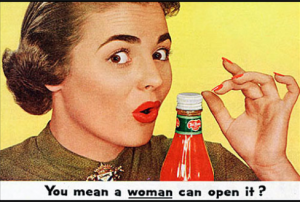
This is an advertisement of a bottle of ketchup, it is generally trying to achieve its audience by representing the bottle as a women's weakness. It is also  representing that women didn't have chances in going first in those days, they were know of not being independent as they were to be the weakest compared to men and more emotional. This advertisement is trying to say that women can do something to surprise the men.

The target audience is mainly aimed at everyone: it can be an advertisement to show that women's do not need to struggle to open the bottle anymore and that men don't need to waste their energy over a ketchup bottle. The target audience is aimed at women's aged between 18-40 year old's and the women is represented as a middle class with interests towards showing their skills and abilities.

In the copy, the word women is underlined, emphasizing that the ketchup bottle is easy enough for women to be able to open it by herself without needing a men's help. This comes from the generalized idea that women are weak, as it can also be seen to have a strong gender stereotype. The image displays the women's face more than the ketchup bottle, which is putting emphasis on the women and how weak women's are. The yellow background creates a bright mood, along with the women's cheerful looking  face expression, as their being represented as independent. Which assists in not making the stereotype a big issue in this advertisement.

Positive Representation


This is an advertisement representing women positively, it is advertising Schlitz beer. In this ad for Schlitz beer, her husbands take's a gentle approach and comforts his young wife, who had a breakdown after burning his dinner.This advertising poster is representing women as more emotional in the 1950's and  not being independent, in need for their husbands help.

The women is in a kitchen, portray's that she is the housewife who cares for kids and does all the cooking for her family.


Monday, November 25, 2013

Advertising Appeal

Advertising Appeal

Need to nurture - every time you see a puppy or a
kitten or a child, the appeal is to your paternal or
maternal instincts.


Monday, November 18, 2013

History of advertising

Advertising
History of advertising

Early Advertising
  • Advertising has been around since humans started providing each other with goods and services. It has been agreed to have begun along in newspapers, in the seventeenth century.
  • In England, line advertisements in newspapers were popular. The great fire of London in 1666 was a boost to this type of advertisement as people used newspapers to advertise.

Advertising and the Industrial Revolution
  • When goods where handmade by local craft man in small quantities, there was no need for advertising. Buyer and seller where known to one another. Packaging and branding were unknown and unnecessary before the industrial revolution.
  • Manufacturers needed to explain and recommend their products to customers whom they would never meet personally. Therefore they needed to brand their products, in order to
    distinguish them from one another, and create mass recommendations to
    support the mass production and consumption model. Newspapers provided the
    ideal vehicle for this new phenomenon, advertisements.

Bubbles- The pears soap advertising Innovation
  • An early advertising success story is that of Pears Soap. Thomas Barratt married into the famous soap making family and realised that they needed to be more aggressive about pushing their products if they were to survive. He bought the copyright to a painting by noted
    Pre-Raphaelite artist, Sir John Everett Millais, originally
    entitled 'Bubbles'.

The first advertising agencies
  • It was not until the emergence of advertising agencies in the latter part of the nineteenth century that advertising became a fully fledged institution, with its own ways of working, and with its own creative values.
  • A good early example of this is the advertising produced for Arrow Shirts by the copywriting team of Earnest Calkins and Ralph Holden, who hired Joseph Leyendecker to create an image for the campaign.

Advertising and the first world war
  • Poster advertising was much more common in Europe than the US before 1914. When war broke out, all the various governments involved turned to posters as propaganda.
  • One of the other consequences of World War I was the increased mechanisation of industry – and increased costs which had to be paid for somehow: hence the desire to create need in the consumer which begins to dominate advertising.

Advertising through the great Depression
  • Advertising quickly took advantage of the new mass media, using cinema, and to a
    much greater extent, radio, to transmit commercial messages to a widespread audience.
    The first radio ad appeared in 1922, and,because direct selling was not permitted,
    broadcast a 'direct indirect' message about the benefits of living in a particular development in
    Jackson Heights, New York
  • Advertising spending plummeted by around 60% after the Crash, and didn't return to 1920s levels until the early 1950s - although radio advertising spend did increase significantly in this period. Ad agencies were hard hit, often having to downsize considerably as the clients dried up.

Advertising and TV
  • The UK and Europe, with government controlled broadcasting, were a decade or so behind America in allowing commercial TV stations to take to the air, and still have tighter controls on sponsorship and the amount of editorial control advertisers can have in a programme.
  • Several different advertisers could buy time within one show, and therefore the content of the
    show would move out of the control of a single advertiser - rather like a print magazine. This became known as the magazine concept, or participation advertising, as it allowed a whole variety of advertisers to access the audience of a single TV show.

Madison Avenue - how the Mad Men came to be
  • By the 1950s, advertising was considered a profession in its own right, not just the remit of failed newspapermen or poets. It attracted both men and women who wanted the thrill of using their creativity to make some serious cash.
  • To that end copy and pictures had to be clear, simple, and provide a direct connection
    between customer and brand. He specialized, in the early days, in attention-grabbing campaigns that relied on a clever idea rather than a huge budget. One of his earliest, most successful was for Hathaway Shirts.

Sunday, November 10, 2013

Advertising

                                                               Advertising

Tv advert


I like this advert as it makes me laugh. It is an entertaining and a catchy advert, the catchy background  music, the annoying expressions and the balloon sound compliment keep the eyebrows dance and the song stuck in your head. This also keeps you intrigued, watching the two kids moving their eyebrows in such fluid motions, confuses everyone how they do it.


Printed Advert


I like this printed advert because whenever I see it, it always reminds me of Christmas and the presents you'll receive on Christmas day. This advert also reminds me that the school holidays are also closer, which means there's more times for watching TV, sleeping and shopping all day long. I  also desires  to go and by the product, which is the coca cola, as I love the shape of the new product and  I will enjoy drinking it. It is one of my favourite drinks. The colours catches the audiences attention, as red is a colour of love and energy, which distributes you with the product with love and happiness.


Monday, October 21, 2013

Conventional Elements (Codes and Conventions)


Conventional Element


How is it used in Action/Adventure films?

Protagonist

The protagonist of a story is often called the main character. The plot revolves around the protagonist. There may be more than one main character. Protagonists are the good heroes of the films, they are usually are represented  as being confident, reliable, special, and the hero of the story, also stereotypically handsome. They usually wear bright colours, which symbolizes its arises from its powerful association in stories, this also signifies passion, danger and warnings.


They have different costumes which associates the warm and positive colours that tells us they have a good personality, associating with the most physical needs. 


Antagonist

The antagonist is the character who represents a challenge or an obstacle to the protagonist in a story. In some stories, the antagonist is not a person! The antagonist is used as the bad villains, who destroys  their relationship with others in order to take revenge . They are represented as being selfish, dishonest, and bad because of their costume and facial expressions.


They usually wear dark colours such as the colour black and purple. These colours are often used to portray something evil, depressing and scary. It is also a very powerful colour that portrays elegance and wealth, It is also a negative colour which appeals to the audience that there is something bad going on.


Other

Action scenes (car chases, races, battles)

In  action adventure Scenes are important to an Action Adventure film audience. They are usually the scenes that audiences enjoy the most as they create the most excitement. Action scenes are what audiences associate with watching Action Adventure films.


Violence

Action Adventure films often made violence look unrealistic with heroes being massively bigger, scary opponents and still winning fights. Action Adventure heroes would suffer punishment that would seriously injure or kill people in the real world and yet they would often survive with minor or no injuries. Action Adventure films often made violence look attractive by being exciting and often funny.


Plot

Plot is not just what happens in a story. Rather, plot is a pattern of cause and effect or conflicts upsetting  a situation. Plot is characters responding to those conflicts into some form of resolution.

Similarly, the plot in a film is not just what happens. The theme or message is the main point or points that the viewer draws from the way the characters respond to the obstacles or resolve the conflict in the film.


Location

The locations are used in action adventure films to show the setting of the film, where the film is located and the scenes going on. Action Adventure films shoot scenes in some exotic or far away locations that most people would have never visited. This makes the films more attractive as the audiences can see countries that they will never probably have seen in real life. However, some action adventure films are displayed in cities which are commonly known.


Soundtrack


Sound tracks are often as complicated as the image on the screen. Background music is used to add emotion and rhythm to a film. Usually not meant to be noticeable, it often provides a tone or an emotional attitude toward the story and/or the characters. This also views the understanding by linking scenes. It also builds tension and creates suspense for the audience, knowing what's happened.


Camera

Camera shots are used to demonstrate different aspects of a film's setting, characters and themes. Camera shots are very important in shaping meaning in a film. 

Camera angles are used to position the viewer so that they can understand the relationships between the characters. It very important for shaping meaning in film as well as in other visual texts.


Mise en Scene

Mise en scene refers to all the objects and characters in a particular frame. More specifically, it refers to the composition of the frame. When you use the term mise en scene, you are discussing where the setting is held to show the audience. This includes  – the setting and the actors; it includes costumes and make-up, props.


Editing

Editing is a way to form a narrative, both in the making and the viewing of a film. Editing speeds up the shooting process in ways outlined earlier it speeds up the viewing process by creating a rhythm of forward action. Editing describes the relationship between shots and the process by which they are combined.


Genre
This terminology is used in  a way of categorizing a particular media texts according to its context and style,it adopts the codes and conventions of other texts in the same genre,For example, the TV programme 'doctor who' and a comic book the' incredible hook' can both be categorized as a science fiction.


Representation

Representation is when the way people,places,and events are portrayed in the media and the message it sends.When representing a person media often focuses on their:age, gender, ethnicity, job,culture and nationality.To represent also means to symbolise,stand for,for example when you see a sign you can relate it to something, which represents it. Things can be described as re-presentation of things, so the media can represent the world.